Passing of a Miracle Mile, Inter Dominion legend
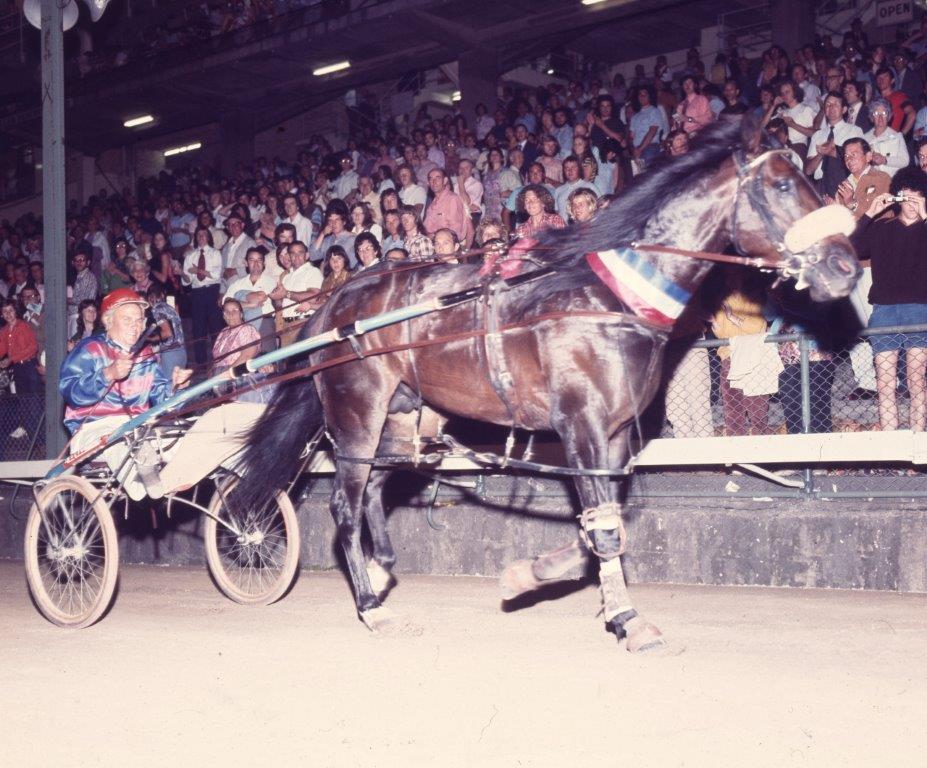
FROM a humble vegetable grower to a legend in his own lifetime – that was the journey taken by the man known in harness racing simply as ‘AD’.
There’s no need for the surname. Just as Bart and Gai were always identified by their first names for their deeds in thoroughbred racing, so too is ‘AD’ recognised by his initials for his achievements in the harness field.
In his home town of Bathurst, even non-racing folk knew of Anthony Dale (Tony) Turnbull who, sadly, passed away this morning at the age of 91 after suffering a stroke a week earlier.
He and his champion pacer of the 1970s, Hondo Grattan, were, and still are, household names. They are as synonymous with Bathurst as the car racing at Mount Panorama.
A D lived all his life at The Lagoon, a little hamlet 16km outside Bathurst, and through his children and grandchildren, established a harness racing dynasty that will enrich the industry for years to come.
In the late 1940s, he worked on the family property growing vegetables, mainly cauliflowers, for market and dabbled in trotting as a hobby. Fifty years later, as a professional trainer-driver, he was inducted by Harness Racing NSW as the State’s first official Living Legend of harness racing, such was the impact he and his one-time hobby had on what today is not only a sport, but an industry.

There were many other “firsts” in Tony Turnbull’s long and illustrious career. He was the first driver in Australia to land 2000 winners; the first to win the Inter Dominion in consecutive years (scoring with Hondo Grattan in 1973 and ’74) and the first to win the Inter Dominion and Miracle Mile in the same year (again with Hondo Grattan in 1974).
By the time he’d finished, he was one of the nation’s most decorated horsemen. Before being named as a Living Legend in 1998, he received an Order of Australia Medal (OAM) in 1990 for his services to harness racing. Two years prior to that, he was inducted into the NSW Hall of Champions in the State Sports Centre at Homebush, one of only three trotting participants to be accorded this honour.
Additionally, he was selected as Australia’s representative in the World Driving Championship in Canada in 1987, received the now defunct NSW Media Guild’s Appreciation Award in 1990, was included on the Bathurst Council’s Sportspersons’ Honour Roll in 1991 and was named Bathurst Gold Crown Honouree in 1994 and Bathurst Citizen of the Year in 1995.
And for good measure, in 1999, when the NSW Harness Racing Club commemorated the 50th anniversary of night trotting in Sydney by opening an Industry Museum at Harold Park, he was inducted into the Museum’s Hall of Fame along with three other champion reinsmen, Kevin Newman, Vic Frost and Brian Hancock.
The above is a brief summary of Tony Turnbull’s racetrack achievements, but there was a lot more to him than that. A D portrayed all the good things about what he and I and others of our vintage called trotting, but today is known as harness racing. That, and the fact I thought there should be a permanent record of his achievements, is why I wrote the book A Legendary Reinsman – the A D Turnbull Story, published in the year 2000.
There are other trainers and drivers equally as competent as A D and some perhaps better. But what set this self-titled “bloke from the bush” apart from most of the others, was his all-round horsemanship, his incredible work ethic and dedication, his loyalty and his indomitable will to win.
As a horseman, Tony could do the lot – from breaking-in, educating and shoeing horses to training and driving them – and he never seemed to tire.
Even in his sixties and early seventies he would drive at four or five meetings a week travelling thousands of kilometres in the process. Indeed, at the turn of the century he said he’d worn out four new trucks and two second-hand ones in 50 years of carting horses over two million kilometres from his home base at The Lagoon to win races.
On the racetrack he was a fearless competitor who drove aggressively. He asked no quarter and gave none. As my good friend, the late Bill Whittaker pointed out in the foreword he wrote to
A Legendary Reinsman, the pain of many race falls and suspensions never seemed to dull his aggression or his will to win.
Tony Turnbull was born on January 21, 1930. He was reared during the Great Depression, as was another champion horseman in J B (Bart) Cummings who was born three years before him.
Like Bart, A D was a shy self-effacing man, and also like Bart, he grew to possess the same dry wit and laconic sense of humour that made each a master of clever one-liners which they used frequently when interviewed by the media.
A D was the third of four children to William George Turnbull and his wife Ellen. Along with his elder brothers Joe and Jim and his sister Fay, he was raised at The Lagoon on a farm which would later become well known as the “Loyal” Stud.
Tony’s father and his uncle, Albert Turnbull, better known as “Captain” Turnbull, ventured into trotting in the 1920s and in due course, A D and his brothers followed in their footsteps. A D despite being the youngest of the three, was the first to do so.
At the time, he was learning from his father the business of growing and marketing vegetables while helping his uncle with the horses. As he often said, it was Captain Turnbull who took care of the horses and taught him the fundamentals of trotting while his (Tony’s) father looked after the punting side of the stable.
A D drove his first winner at age 17, scoring on Knock Out, a pacer owned by his mother, at the old Katoomba Showgrounds track on May 3, 1947. He won his first race at Harold Park on Walla Charm on June 19, 1948 (during the day trot era) and his first there at night trots on the same pacer at the third meeting held under lights on October 15, 1949.
Four decades after his first winning drive, A D achieved a special milestone in his career by becoming the first driver in Australia to land 2000 winners, reaching that mark by scoring with a pacer called Nintoku at Richmond on April 28, 1987. His last winner as a driver was posted aboard What Can I Say at Fairfield on July 29, 2002.
In all, Tony Turnbull drove 2878 winners, but despite this imposing figure, he never won a Harold Park trainers’ or drivers’ premiership. He did however, win the NSW drivers’ premiership 11 times and topped 100 winners for a single season 12 times.

The brilliant but sometimes erratic Loyal Raider was a good winner for A D in the early 1950s as was one of that pacer’s sons, Miniature Bill, who won 37 races including eight at Harold Park against tough opposition.
We can’t list all of his other winners here, but some of the better ones he drove to victory during his 55 years in the sulky included Lilla Brava, Lachamfer, Group Nine, Mark Andrew, Just So, Loyal Satin, Storm Again, Sunset Hanover, Mac’s Gift, Sling Along, Tarport John, Radiant Group, Cruise Along, Ring Of Light, Swift Hanna, Frosty Jim, Woody One, Bardmoore Bay, Mister Meggs, Karloo Frost, Dual Brigade, Keystone Major, Roman Origin, Spirit Of Rhett and For Loveofthegame.
For all those winners though, there was one horse that mattered more than any other – Hondo Grattan. The Bathurst Bulldog, as Hondo Grattan became known, and Tony Turnbull were two of a kind – tenacious and tough – which made them the perfect racetrack combination.
They competed in the 1970s at a time when Australia was never richer in pacing talent, and they met and defeated the best. Their wins became legendary, and their clashes with arch rivals Paleface Adios and Colin Pike, a part of harness racing folklore as they blazed a trail across Australia to become the toast of the nation.
Bathurst honoured them with a civic reception, a song called “Little Hondo” was composed in the champion pacer’s honour and within a few years horse and driver had two Inter Dominions and a Miracle Mile to their credit.
To this day, Hondo Grattan’s last-stride defeat of Paleface Adios in the 1974 Miracle Mile is rated by many fortunate enough to see it, myself included, as the most thrilling in the history of the race. Overall, Hondo Grattan started 120 times for 58 wins and 36 minor placings earning $215,402 in prizemoney for A D and co-owners Bill and Bob Webb.
As well as his Miracle Mile and two Inter Dominion wins with Hondo Grattan, A D claimed many other major victories.
They included a Carousel with Loyal Satin, an Edgar Tatlow Stakes and Australasian 4YO Championship with Sunset Hanover, a Ladyship Mile with Mac’s Gift, a Breeders’ Plate with Cruise Along, a Pink Bonnet and Raith Memorial with Ring Of Light, a NSW Sires’ Stakes final with Karloo Frost and three HP Lord Mayor’s Cups (two with Hondo Grattan and another with Dual Brigade).
A D had three great loves in his life – his wife and family, his Church (he was a devout Catholic) and harness racing. He married his childhood sweetheart, Shirley in 1950 and they had six children, Anne, Greg, Steve, Therese, Craig and Cindy, in that order.
All but Therese followed their father into harness racing and three of them, Steve, Craig and Cindy, are still heavily involved as are several grand children, particularly Emma, Jason, Amanda, Nathan, Josh, Mitchell and Abbey (all Turnbulls), Mark Tracey and Will, Ellen and Hannah, (the children of Peter and Cindy Rixon).
Tony was devastated when his wife Shirley died suddenly in 1986 following a brain haemorrhage, then suffered the pain of losing his eldest son, Greg to cancer in 1999, but with the support of his family he carried on.
Much to his dismay, he was forced out of the sulky on medical grounds in 2002, but continued to train winners for several years after. He always said it wasn’t the same though, and had he been given his own way, he would have still been driving when he was in his eighties.
During his career, A D broke more bones than he could remember as a result of many race accidents but that didn’t deter him in the slightest. The only time he worried (and then only for a short time) was one day in 1971 when he was knocked out in a fall at Eugowra.
There was no ambulance at the track, so he was put in the back of a van to be taken to hospital. On the way, he woke up and saw a half a dozen cars following the van.
“I thought for a moment it was a funeral procession and I was in the hearse, so I recovered pretty quickly, I can tell you,” he said later.
Because of his aggressive driving A D often incurred the wrath of the stewards and was suspended many times, but he managed to cope with this, even if he didn’t always agree with the stewards’ findings.
What he found hard to deal with, though, was the disqualification he incurred in the twilight of his career. The penalty of nine months (reduced to six months on appeal) was imposed following a high TCO2 (bicarb) reading returned by a winner he trained at Forbes in April, 2000.
Tony was nursing a broken collarbone at the time and didn’t attend the Forbes meeting. He protested his innocence. It was the only time he’d ever been disqualified and he felt his reputation and good name had been tarnished.
But Judge Barrie Thorley, head of the then Appeals Tribunal that shortened the period of disqualification, made it clear “there was not the slightest suggestion” that A D himself had done anything which could have accounted for the high TCO2 level.
“How that level was achieved has not been explained, but we are satisfied that it was not due to any active role on the part of the appellant,” said Judge Thorley said at the time.
“He should not feel his reputation has been unnecessarily sullied. However, he must, as will any other trainer, bear the responsibility for the final result.”
Clearly, A D was blameless in the whole affair, and as Judge Thorley pointed out, lost no standing in the industry as a result of the disqualification. Indeed, to this day, he remains one of harness racing’s true legends and an ornament to the game.
- HARRY PEARCE